

NewsUncategorized
A ceramic vacuum chuck may look like a relatively simple precision plate, but machining one for semiconductor equipment can involve demanding requirements for flatness, hole geometry, surface finish, dimensional accuracy and cleanliness.
The challenge becomes greater when the component is made from a hard and brittle ceramic such as alumina, aluminum nitride or silicon carbide.
Therefore, for us and other processing suppliers, the key challenge lies in meeting the geometric and vacuum-structure tolerance requirements without compromising the functional surfaces.
A ceramic vacuum chuck is a precision component that uses vacuum pressure to hold a wafer, substrate or other workpiece against a defined support surface.
Depending on the equipment design, vacuum can be distributed through different structures, including:
Ceramic vacuum chucks can be used in applications such as wafer inspection, metrology, grinding, polishing, wafer handling and other precision semiconductor equipment.
The exact chuck structure depends on the wafer size, workpiece condition, vacuum requirements, process environment and required positioning accuracy.
This distinction is important because a dense ceramic chuck with machined holes and grooves is manufactured differently from a porous ceramic vacuum chuck.
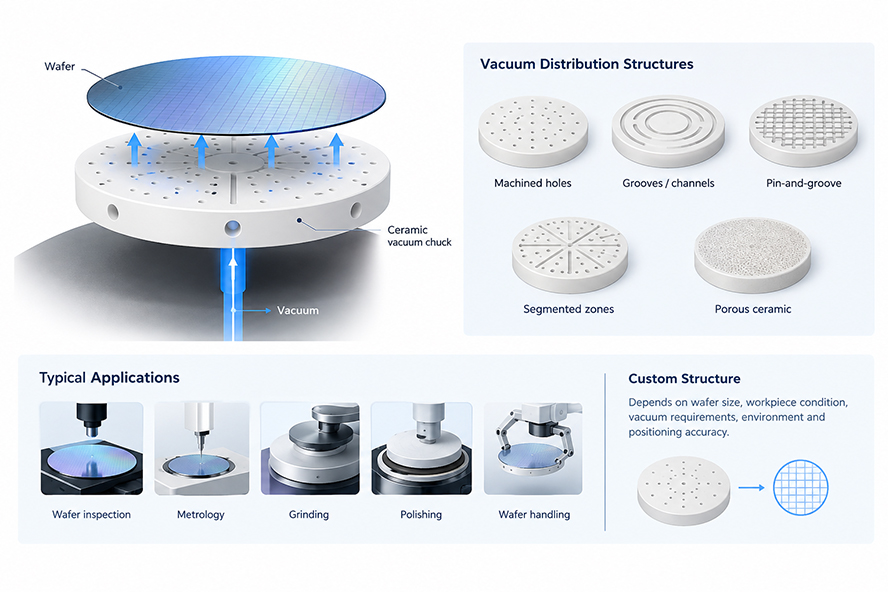
Ceramics can provide a combination of properties that is useful in semiconductor equipment, including electrical insulation, hardness, wear resistance, thermal stability and dimensional stability.
Of course, Material selection should be based on the actual equipment and process requirements.
For many ceramic vacuum chuck applications, alumina offers one of the best overall balances between performance, manufacturability and cost.
It provides excellent hardness, electrical insulation and chemical resistance, making it suitable for a wide range of semiconductor equipment environments. At the same time, alumina is one of the more mature technical ceramics in terms of machining technology and material availability.
This maturity also makes alumina relatively cost-effective compared with more specialized ceramics. For applications that do not require the higher thermal conductivity of AlN or the extreme wear and chemical resistance of SiC, alumina can often be a highly practical choice.
Aluminum nitride is attractive for applications where thermal conductivity and electrical insulation are required at the same time.
Its thermal properties can make it useful for ceramic components exposed to significant thermal loads.
Compared with alumina, AlN generally involves higher material and machining costs, so its thermal performance should provide a meaningful advantage for the intended application.
Silicon carbide offers high hardness, wear resistance, thermal stability and chemical resistance.
These characteristics make SiC suitable for demanding semiconductor equipment applications.
Its high hardness, however, also makes precision machining more challenging. Diamond-based grinding and carefully controlled machining processes are commonly required for demanding SiC geometries.
SiC can therefore provide advantages in particularly demanding environments, but its material and machining costs may be significantly higher than those of alumina.
Before discussing machining, it is important to understand that ceramic vacuum chucks can have significantly different structures.
A dense ceramic chuck can be machined with a defined pattern of vacuum holes and grooves.
Important dimensions may include:
For these components, the dimensional relationship between the vacuum features and the working surface is important.
A small hole-position error may be insignificant for one application but unacceptable for another, depending on the wafer size and vacuum pattern.
Some wafer chucks use raised support areas or pin structures combined with vacuum channels.
The support pattern can reduce the actual contact area between the wafer and the ceramic surface.
This type of structure introduces additional machining requirements because the height and distribution of the support features must be controlled together with the overall flatness.
Porous ceramic chucks use interconnected pores rather than relying only on individually machined vacuum holes.
Their performance depends on properties such as:
Higher porosity does not automatically mean better vacuum performance. The appropriate pore structure depends on the required airflow, vacuum response, holding behavior and mechanical requirements.
Porous ceramic chucks should therefore be treated as a different manufacturing category from dense machined ceramic chucks.
Flatness is one of the first things we look at when machining a ceramic wafer chuck.
The working surface needs to provide a stable reference for the wafer. But in practice, flatness alone doesn’t determine how well the chuck will perform.
Wafer bow, vacuum distribution, support pattern, contact area, chuck size and thickness, surface finish, and temperature can all affect the final result.
So we don’t simply say that every wafer chuck needs “flatness <1 μm.” Sub-micron flatness is possible, but whether it is necessary — and whether it is the right target — depends on the actual design.
At Jundro, we look at the complete part before setting the flatness requirement, including the material, size, thickness, geometry and other tolerances.
Surface roughness is another important factor for the wafer-contacting surface.
But here, smoother is not always better.
A rough surface can affect wafer contact and particle behavior, while an overly smooth surface may not provide any real benefit for certain chuck designs.
The right roughness depends on the chuck structure, wafer material, contact pattern and process requirements.
Machining a ceramic vacuum chuck is not just about achieving tight dimensions. The real challenge comes from combining a hard, brittle material with complex and precise geometry.
Ceramics can chip easily when machining forces are not well controlled.
Vacuum holes, grooves, slots and outer edges are especially sensitive, particularly around small holes and thin sections.
Tool condition, cutting parameters, workholding and machining sequence all have an impact on the final edge quality.
Small vacuum holes can be one of the more difficult features to machine.
It is not only about hitting the right hole diameter. Hole position, depth, straightness and the condition of the entrance and exit edges also matter.
When a hole passes through a thin section, breakout and edge chipping become more likely.
Large ceramic surfaces bring a different challenge.
Material needs to be removed evenly across the entire surface, while maintaining flatness and parallelism.
Grinding sequence, remaining stock and inspection become especially important when tight tolerances are required.
Thin walls, narrow ribs and closely spaced grooves are more sensitive to machining forces and handling.
For these features, the machining sequence and support method need to be considered before production starts.
Sharp ceramic corners are difficult to produce without some risk of chipping.
When the design allows it, a small radius or chamfer can make the part easier to manufacture and improve edge reliability.
That is why we prefer to review the drawing before machining — sometimes a small design change can make a significant difference to the final part.
There is no single manufacturing route suitable for every ceramic vacuum chuck.
For dense ceramic components supplied as machinable blanks, a typical process may include:
Material preparation → rough machining → precision grinding → CNC feature machining → secondary grinding/finishing → dimensional inspection → surface inspection → ultrasonic cleaning → final inspection → controlled packaging
There is no single machining sequence that works for every ceramic chuck.
We look at the material, blank condition, overall size, hole and groove geometry, flatness, surface roughness and dimensional tolerances before deciding how to machine the part.
For complex geometries, 5-axis CNC machining may be used to reach angled surfaces and features that are difficult to machine from a conventional direction.
For large reference surfaces, precision grinding is often the critical step for controlling flatness, parallelism and thickness.
For semiconductor-related components, machining accuracy is only part of the requirement.
Ceramic vacuum chucks often have small holes, grooves and recessed areas where particles or machining residue can remain if cleaning is not properly controlled.
After machining and inspection, ultrasonic cleaning can be used where appropriate to remove residual particles and contaminants.
At Jundro, cleaning and packaging can be carried out in Class 1,000 and Class 10,000 cleanroom environments, depending on the customer's requirements.
This is important because a precision surface can be contaminated after final inspection if handling and packaging are not properly controlled.
The required cleanliness level should be defined according to the customer's equipment and process requirements, rather than simply based on the ceramic material.
Jundro specializes in machining hard and brittle ceramics for semiconductor equipment and other high-precision applications.
Depending on the part, our manufacturing process may include 3-axis, 4-axis or 5-axis CNC machining, precision grinding, hole and slot machining, surface finishing, dimensional inspection, ultrasonic cleaning and controlled packaging.
We work with materials including Al₂O₃, AlN, SiC, Si₃N₄, ZrO₂, Macor and other technical ceramics, depending on the application.
For a ceramic vacuum chuck, we don't look at the part as simply a ceramic plate with holes in it.
We consider the material, geometry, vacuum features, tolerances, surface requirements and inspection requirements together when reviewing the part and deciding how it should be machined.
This becomes especially important when working with hard and brittle ceramics for semiconductor equipment.
If you have a ceramic vacuum chuck drawing or STEP file, send it to us. We can review the geometry and requirements, assess machining feasibility and prepare a quotation.

Chinese (Simplified)

English

German

Japanese

Spanish
Floors 1-2, Building 3, Qianyuan Industrial Park, No. 2 Gaoxin 2nd Road, Dalang Town, Dongguan, Guangdong, China(523770)


