

NewsKnowledges
Semiconductor equipment manufacturers spend millions of dollars each year to improve plasma etching performance, but a small component can affect chamber uptime, particle size, and wafer yield—that is the etching ring.
High-purity alumina has always been the preferred material for the focusing ring and edge ring in plasma etching equipment. However, with the rapid development of current technology, the performance requirements for chamber components are also gradually increasing. The goal is not only to ensure normal operation within the chamber, but also to maintain maximum dimensional stability, minimize particles, and sustain stable plasma conditions throughout the entire process.
Currently, silicon carbide is gradually replacing alumina as the preferred choice for semiconductor etching rings, for the following reasons.
Because the focusing ring is mounted around the wafer to control plasma distribution, it is exposed to conditions such as CF₄, NF₃, SF₆, Cl₂, BCl₃, and radio frequency electromagnetic fields for extended periods during operation. This exposure continuously erodes the surface of the etching ring, leading to changes in uniformity, shortened lifespan, and increased maintenance frequency. In this environment, replacing worn components is not only a matter of material costs, but each maintenance cycle may also lead to equipment downtime and production interruptions.
| Property | Alumina | SiC |
|---|---|---|
| Density (g/cm³) | 3.9 | 3.1 |
| Thermal Conductivity (W/m·K) | 30 | 110 |
| Flexural Strength (MPa) | 416 | 450 |
| Young's Modulus (GPa) | 358 | 430 |
| Hardness (GPa) | 18 | 29 |
| Wear Resistance | Good | Excellent |
| Particle Resistance | Moderate | Excellent |
In plasma etching applications, the key difference lies not in electrical properties, but in the combined effects of hardness, thermal conductivity, and resistance to surface degradation. These characteristics directly influence the wear rate of components and the amount of contamination that may occur during use.
The ultra-high hardness of silicon carbide provides it with superior resistance to surface wear, enabling it to maintain its shape without deformation for a longer period of time.
Silicon carbide can maintain its surface integrity more effectively under harsh processing conditions, and is therefore often used in applications where the primary goal is to reduce particle size.
The thermal conductivity of SiC is second only to that of aluminum nitride among these materials and is 3.5 times higher than that of alumina ceramics, enabling it to effectively stabilize component temperatures.
In our actual processing, many customers have reported that replacing alumina with silicon carbide significantly extends the maintenance cycle of parts.
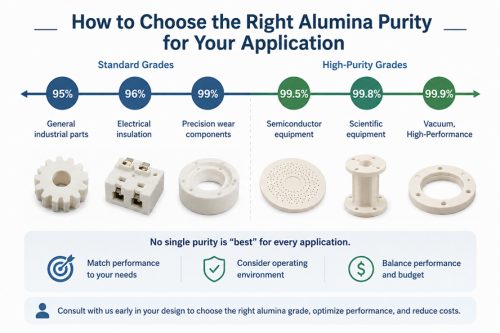
It is important to understand that not all silicon carbide is the same; even alumina has different purity grades.
Suitable for large parts, with high mechanical strength
Higher density, wear resistance and dimensional stability
High-purity silicon carbide with a dense, non-porous surface
Highest purity SiC
There is no universal material for every plasma-facing component.
Alumina remains a practical choice for many insulating and structural applications.
However, for focus rings and edge rings that must simultaneously deliver wear resistance, thermal stability, and long service life, silicon carbide is gradually replacing alumina in the market.
Jundro Ceramics provides custom silicon carbide machining services for semiconductor equipment manufacturers, research institutions, and advanced technology companies worldwide. Whether you require prototype development or high-precision production components, our team can support your project with reliable manufacturing solutions and fast technical assistance.



Chinese (Simplified)

English

German

Japanese

Spanish
Floors 1-2, Building 3, Qianyuan Industrial Park, No. 2 Gaoxin 2nd Road, Dalang Town, Dongguan, Guangdong, China(523770)