

NewsKnowledges
The challenges materials face in vacuum systems are entirely different from those in ambient-pressure environments. Even the slightest outgassing from within a material can affect the vacuum level, contaminate sensitive components, and compromise the performance of the entire system. Technical ceramics, however, are widely used in vacuum equipment—particularly in semiconductor manufacturing, scientific research, and high-vacuum electrical systems—due to their excellent properties, such as low outgassing, low porosity, and thermal stability.
Of course, not all ceramics are suitable for vacuum environments. When making a selection,we must consider several key prerequisites:
Among these requirements, low outgassing deserves particular attention. A 2021 study published in the Journal of Vacuum Science & Technology B found significant differences in outgassing behavior among different ceramic materials. This means that simply choosing a dense ceramic is not enough to guarantee good vacuum performance.
With these requirements in mind, let’s look at five ceramic materials worth considering for vacuum applications.
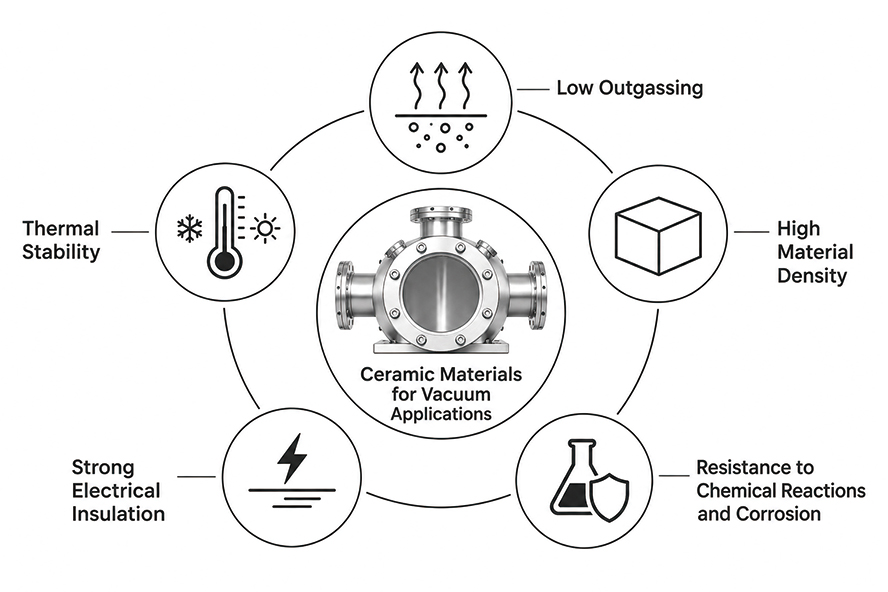
The following five ceramic materials are suitable for a wide range of vacuum applications. Each offers distinct advantages, and the best choice should be made based on the specific application environment and cost considerations.
It is no coincidence that alumina is the most widely used ceramic material in industrial applications. In vacuum applications, the advantages of alumina include:
Summary: Alumina is not a ceramic material that excels in any single property; its true advantage lies in the balance between performance and cost
When vacuum components require complex geometries, multiple holes and narrow slots, or highly precise internal structures (such as ion trap supports), traditional technical ceramics are extremely difficult to machine—often resulting in chipping—and require design adjustments just to be machinable. Macor, however, offers unique advantages in this regard
Summary: Its zero porosity and exceptional ability to form highly complex shapes are Macor’s greatest advantages in vacuum applications; however, it is not suitable for parts that must withstand loads or high temperatures.
Many vacuum equipment components require both excellent electrical insulation and good heat dissipation. Aluminum nitride can meet these requirements, but machining becomes a challenge for complex parts. Shapal Hi-M Soft effectively fills this gap, offering a thermal conductivity as high as 92 W/m·K while providing the same exceptional machinability as Macor.
Summary: Shapal is only suitable for applications that meet the conditions described above. For most vacuum components, it is too costly; therefore, you should weigh the pros and cons based on your specific application.
In vacuum systems, managing heat can be more challenging than in conventional industrial environments. Since the absence of air significantly reduces heat transfer through convection, components often rely on solid materials to conduct heat away from critical areas.
For applications where heat dissipation and electrical insulation are both required, aluminum nitride (AlN) is one of the most attractive ceramic materials available.
The advantages of aluminum nitride include
extremely high thermal conductivity—its thermal conductivity typically ranges from 170 to 230 W/m·K
and a low coefficient of thermal expansion, which effectively reduces thermal expansion mismatch issues
Summary: Aluminum nitride offers clear advantages for vacuum applications and is well-suited for thermal management components; however, it also has significant limitations. For vacuum applications that do not require high thermal conductivity, it is too costly.
Vacuum applications require more than just thermal and electrical insulation; it is also crucial that components remain stable and wear-resistant under mechanical loads. In such scenarios, silicon carbide emerges as another excellent solution.
Summary: Silicon carbide is suitable for precision components in vacuum equipment that have strict requirements for rigidity and dimensional stability. The drawback is that the material is too hard, making the machining of complex structures relatively costly.
| Properties | (Al₂O₃) | Macor | Shapal Hi-M | (AlN) | (SiC) |
|---|---|---|---|---|---|
| Thermal Conductivity (W/m·K) | 30.8 | 1.46 | 92 | 179.2 | 110 |
| Electrical Resistivity (Ω·cm) | 10¹⁶ | 10¹⁷ | 10¹⁵ | 10¹⁴ | 10¹¹ |
| Maximum Operating Temperature (°C) | 1,765 | 800 | 1,900 | 1,350 | 1,600 |
| Mechanical Strength / Stiffness | High | Moderate | Moderate | High | Very High |
| Machinability | Difficult | Excellent | Good | Difficult | Very Difficult |
| Chemical Resistance | Good | Good | Good | Good | Excellent |
Electrical Insulators and Electrode Supports: Ceramic spacers, insulating bushings, electrode clamps, and support assemblies
Thermal Management Components: Insulated heat spreaders, thermally conductive substrates, and vacuum heating system components
Precision Structural Components: Insulated fixtures for vacuum positioning systems, insulating supports, and mounting assemblies
Semiconductor and Plasma Processing Components: Vacuum suction cups, vacuum chambers, insulating rings, plasma supports
High-Vacuum Scientific Instruments: Ion source supports, quadrupole supports, ion trap supports, insulating mounting bases, electrode supports
Manufacturing ceramic components for vacuum applications requires more than selecting the right material. Dimensional accuracy, surface quality, cleanliness, and contamination control are equally important, particularly for semiconductor equipment and high-vacuum systems.
For the semiconductor and vacuum applications sectors, Jundro not only provides high-precision machining of components but also offers controlled cleanroom environments (including Class 1,000 and Class 100 cleanrooms) for performing specific cleaning, inspection, and handling processes, thereby minimizing particulate contamination. After final cleaning and inspection, components are vacuum-sealed and properly packaged to protect their surfaces from external contamination during storage and transportation, ensuring they remain clean upon delivery and meet the high standards required for semiconductor and vacuum equipment applications.
There is no single best ceramic material for every vacuum application. Alumina is a versatile choice for general electrical insulation and structural components. Macor is suitable for complex precision-machined parts, while Shapal Hi-M Soft combines machinability with thermal conductivity. Aluminum nitride (AlN) is preferred when high thermal conductivity and electrical insulation are required. Silicon carbide (SiC) is suitable for applications requiring high stiffness, hardness, and wear resistance.
Both materials offer thermal conductivity and electrical insulation, but their main advantages differ. Aluminum nitride generally provides higher thermal conductivity and is suitable for applications requiring efficient heat transfer. Shapal Hi-M Soft is an aluminum nitride-boron nitride machinable ceramic composite that can be machined into more complex geometries. It is a practical option when thermal performance and machining flexibility are both important.
Outgassing is influenced by several factors, including material composition, porosity, surface condition, machining residues, moisture adsorption, and cleaning procedures. Proper ultrasonic cleaning, drying, vacuum bakeout, and suitable packaging can help reduce contamination risks. For critical vacuum applications, actual outgassing performance should be verified through appropriate testing rather than estimated from material density alone.


Chinese (Simplified)

English

German

Japanese

Spanish
Floors 1-2, Building 3, Qianyuan Industrial Park, No. 2 Gaoxin 2nd Road, Dalang Town, Dongguan, Guangdong, China(523770)