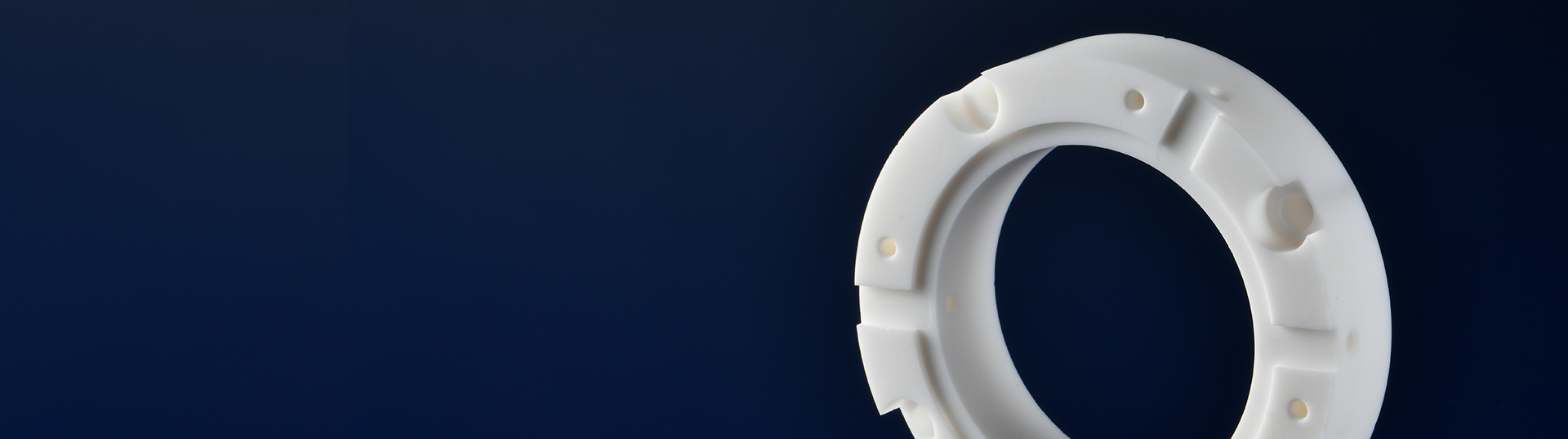
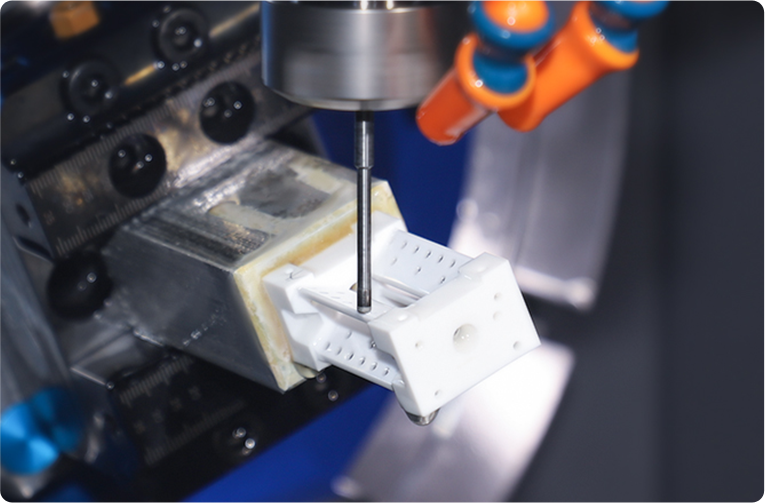
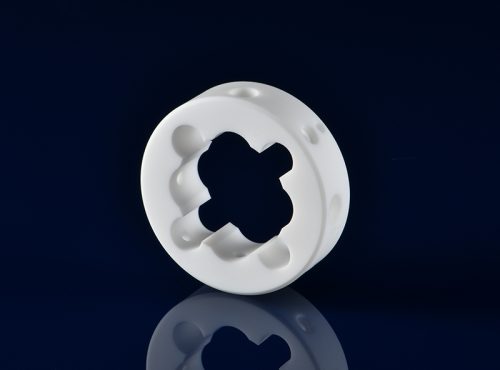
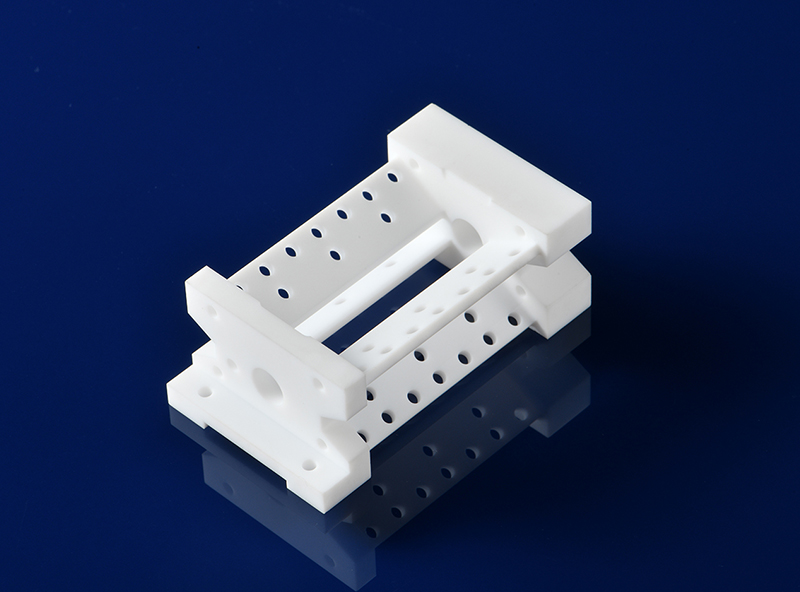
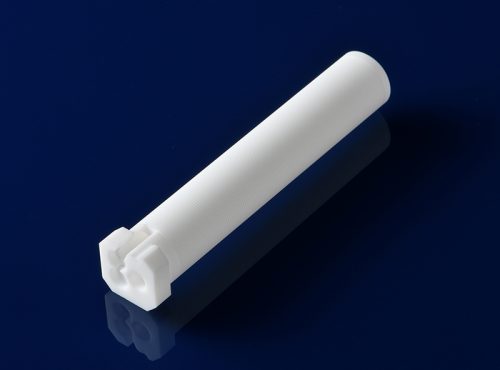
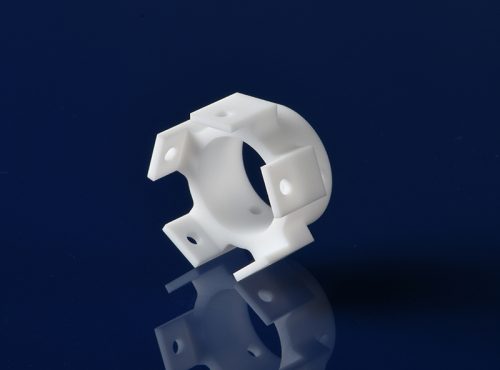
We specialize in precision CNC machining of MACOR® and SHAPAL™ HI-M components for vacuum, quantum optics, semiconductor, and advanced research systems. With 3- to 5-axis machining capabilities, we produce complex geometries with tight tolerances, controlled flatness, and fine surface finishes.(see our [Macor Machining Guidelines]) Our components deliver stable performance in UHV, high-temperature, and electrically insulating environments.

MACOR® features a fine-grained microstructure with zero porosity, ensuring low outgassing and stable performance in vacuum environments. Its controlled thermal expansion and dielectric properties provide reliable dimensional stability and electrical insulation under temperature and voltage stress.
| Thermal | SI/Metric | Imperial |
|---|---|---|
| CTE -100°C – 25°C | 81 × 10⁻⁷ /°C | 45 × 10⁻⁷ /°F |
| CTE 25°C – 300°C | 90 × 10⁻⁷ /°C | 50 × 10⁻⁷ /°F |
| CTE 25°C – 600°C | 112 × 10⁻⁷ /°C | 62 × 10⁻⁷ /°F |
| CTE 25°C – 800°C | 123 × 10⁻⁷ /°C | 68 × 10⁻⁷ /°F |
| Specific Heat, 25°C | 0.79 kJ/kg·°C | 0.19 Btu/lb·°F |
| Thermal Conductivity, | 1.46 W/m·°C | 10.16 |
| Thermal Diffusivity, 25°C | 7.3 × 10⁻⁷ m²/s | 0.028 ft²/hr |
| Continuous Operating | 800°C | 1472°F |
| Maximum No Load | 1000°C | 1832°F |
| Mechanical | SI/Metric | Imperial |
|---|---|---|
| Density | 2.52 g/cm³ | 157 lbs/ft³ |
| Porosity | 0% | 0% |
| Young's Modulus, 25°C | 66.9 GPa | 9.7 × 10&sup6; PSI |
| Poisson's Ratio | 0.29 | 0.29 |
| Shear Modulus, 25°C | 25.5 GPa | 3.7 × 10&sup6; PSI |
| Knoop Hardness, 100g | 250 kg/mm² | — |
| Modulus of Rupture, 25°C | 94 MPa (Minimum | 13,600 PSI |
| Compressive Strength | 345 MPa (up to 900 | 49,900 PSI |
| Electrical | SI/Metric | Imperial |
|---|---|---|
| Dielectric Constant, 25°C | — | — |
| 1 kHz | 6.01 | 6.01 |
| 8.5 GHz | 5.64 | 5.64 |
| Loss Tangent, 25°C | — | — |
| 1 kHz | 0.004 | 0.004 |
| 8.5 GHz | 0.0025 | 0.0025 |
| Dielectric Strength (AC) | 45 kV/mm | 1143 V/mil |
| Dielectric Strength (DC) | 129 kV/mm | 3277 V/mil |
| DC Volume Resistivity, | 10¹⁷ Ohm·cm | 10¹⁷ Ohm·cm |


The optimal substitute for Macor® depends on whether your project prioritizes thermal management, mechanical strength, cost reduction, or direct machinability:
1. Shapal™ HI-M (Best for Thermal Management):
Choose Shapal when both metal-like machinability and high thermal dissipation are required. While Macor has a low thermal conductivity of approximately 1.46 W/m·K, Shapal offers approximately 90 W/m·K (over 60× higher) alongside excellent electrical insulation and UHV compatibility.
2. Hexagonal Boron Nitride (hBN) (Best for High Temperature & Low-Cost Machining):
Ideal for rapid prototyping and high-temperature environments (up to 2000°C in inert atmospheres). Like Macor, hBN can be machined with standard HSS tooling without post-firing, but offers significantly lower raw material costs. Note: hBN has lower flexural strength (~40 MPa vs. Macor's 94 MPa) and is hygroscopic.
3. High-Purity Alumina (Al₂O₃ 99.8%) & Zirconia (ZrO₂) (Best for High Volume & Mechanical Durability):
Best for mass production where high flexural strength (300–2000 MPa) and extreme wear resistance are critical. Unlike Macor, fully sintered Alumina and Zirconia cannot be cut with conventional metal tools and require costly diamond CNC grinding.
Macor is a machinable glass-ceramic made from fluorophlogopite mica crystals embedded in a borosilicate glass matrix. This composition gives it a rare
combination of metal-like machinability, excellent electrical insulation, low thermal conductivity, and stability up to 1000°C (no load) while maintaining very tight tolerances.
Chinese (Simplified)
English
German
Japanese
Spanish
Floors 1-2, Building 3, Qianyuan Industrial Park, No. 2 Gaoxin 2nd Road, Dalang Town, Dongguan, Guangdong, China(523770)