

NewsUncategorized
As power densities continue to increase in semiconductor, EV, aerospace, RF, and industrial electronics applications, substrate materials have become a critical factor in thermal management and long-term reliability.
Among advanced ceramic substrates, three materials are frequently considered:
Each offers unique advantages in thermal conductivity, mechanical strength, thermal shock resistance, and cost.
We will compare these three materials to help you make a clearer choice of the right one.
| Property | AlN | BeO | Si₃N₄ |
|---|---|---|---|
| Thermal Conductivity | 170–230 W/m·K | 250–330 W/m·K | 70–95 W/m·K |
| Flexural Strength | 300–400 MPa | 200–300 MPa | 700–1000 MPa |
| Fracture Toughness | 2.5–3.5 MPa·m½ | 2–3 MPa·m½ | 6–8 MPa·m½ |
| CTE | 4.5 ppm/K | 7–8 ppm/K | 3.0–3.3 ppm/K |
| Electrical Insulation | Excellent | Excellent | Excellent |
| Thermal Shock Resistance | Good | Moderate | Excellent |
| Toxicity Concerns | None | Significant | None |
| Relative Cost | High | Very High | High |
| Semiconductor Adoption | Very High | Limited | Growing |
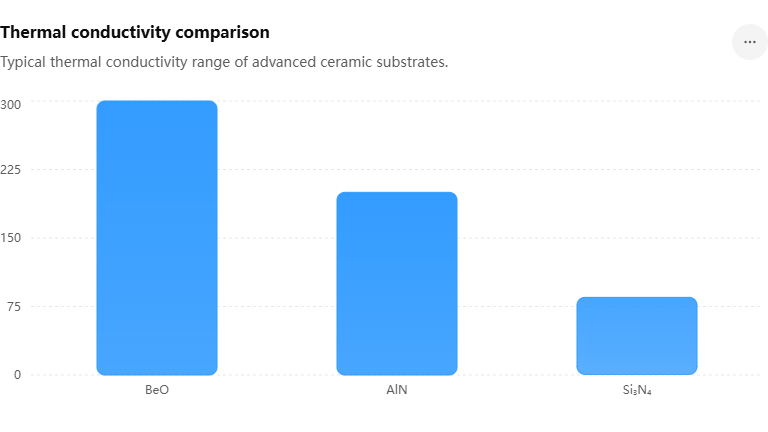
For heat dissipation, thermal conductivity is undoubtedly the most important selection criterion. Among these three materials, alumina (BeO) has the best thermal conductivity, followed by aluminum nitride. Of course, considering only thermal conductivity is not comprehensive.
Because from a mechanical reliability perspective, both AlN and BeO are inferior to Si₃N₄. Compared with the other two materials, silicon nitride has a strength that is 2–3 times higher. At the same time, its fracture toughness is second only to zirconia, and Si₃N₄ also has the best thermal shock resistance among the three materials.Therefore, the final material selection should be made by balancing thermal conductivity requirements against mechanical reliability and service conditions.
Lower CTE generally means better matching with silicon chips.
| Material | CTE |
|---|---|
| Si₃N₄ | 3.0–3.3 ppm/K |
| Silicon | 3–4 ppm/K |
| AlN | 4.5 ppm/K |
| BeO | 7–8 ppm/K |
In terms of cost, the order is silicon nitride → aluminum nitride → beryllium oxide, but the actual price also depends on the size of the material, special processing requirements, and processing difficulty.
In practical applications, I generally see aluminum nitride being selected when thermal conductivity and heat dissipation are the primary concerns, such as in semiconductor wafer processing and packaging equipment. Silicon nitride, on the other hand, is often the better choice when higher mechanical strength, reliability, and resistance to impact or thermal shock are required.
As for beryllium oxide, I have observed that regulatory and handling concerns have gradually shifted much of the market toward aluminum nitride. However, when the application demands exceptionally high thermal conductivity, BeO still remains an important material, particularly in military, aerospace, and other high-performance systems.
In my view, there is no single “best” ceramic substrate material. The right choice always depends on the specific requirements of the application. If I were to simplify the selection criteria:
If the goal is maximum thermal conductivity, I would consider BeO.
If the goal is achieving the best balance between thermal performance and electrical insulation, I would choose AlN.
If mechanical strength, durability, and long-term reliability are the top priorities, I would recommend Si₃N₄.
Ultimately, I believe material selection should start with the application's actual operating requirements rather than focusing on a single property.

Chinese (Simplified)

English

German

Japanese

Spanish
Floors 1-2, Building 3, Qianyuan Industrial Park, No. 2 Gaoxin 2nd Road, Dalang Town, Dongguan, Guangdong, China(523770)


