
NewsKnowledges
When considering silicon carbide for equipment components, you might wonder about the difference between Reaction Bonded Silicon Carbide (RBSiC) and Pressureless Sintered Silicon Carbide (SSiC)—after all, aren't they both silicon carbide?
Our goal today is to explain the differences between these two materials, because choosing the right material isn't about buying the most expensive option—it's about selecting the one that best fits your application. Otherwise, it's like buying a heavy-duty pickup truck when all you really need is a family sedan.
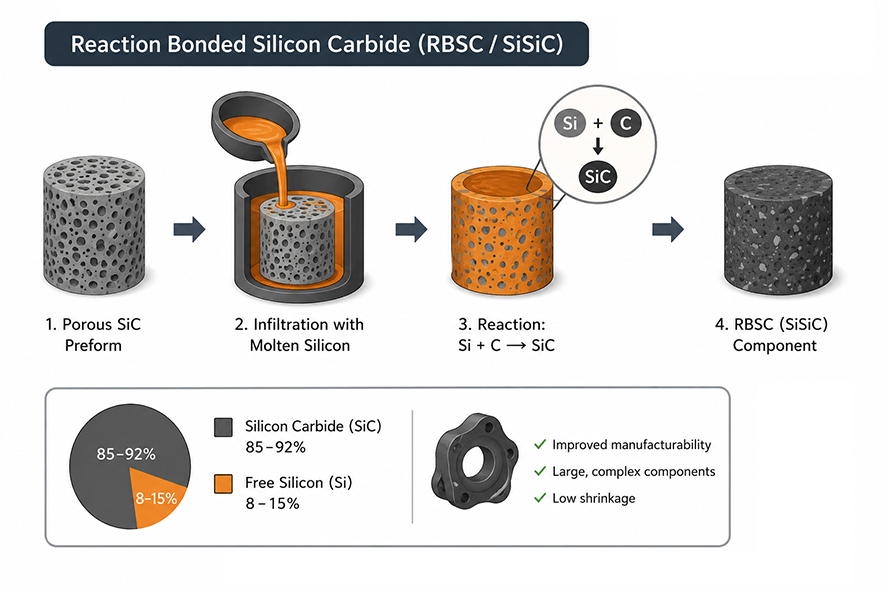
Reaction Bonded Silicon Carbide (RBSC), also known as Silicon Infiltrated Silicon Carbide (SiSiC), is produced by infiltrating molten silicon into a porous silicon carbide preform.
During the infiltration process, molten silicon reacts with carbon to form new silicon carbide, while 8–15% free silicon remains within the material; this improves the material's machinability, making it suitable for large, complex components.
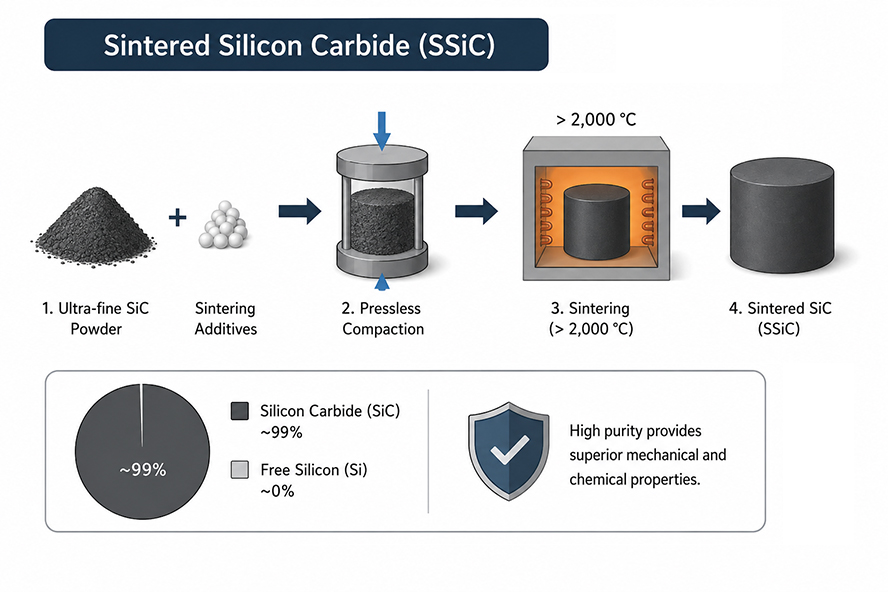
Sintered silicon carbide (SSiC) is produced by mixing ultra-fine silicon carbide powder with sintering aids and sintering the mixture at temperatures exceeding 2,000°C.
Unlike reaction-bonded silicon carbide (RBSC), SSiC contains virtually no free silicon, with a silicon carbide content of up to 99%.
This high purity imparts excellent mechanical and chemical properties to SSiC.
| RBSiC | SSiC |
|---|---|
| Near-net-shape manufacturing | Extremely high hardness |
| Excellent dimensional stability | Excellent corrosion resistance |
| Large component capability | Higher flexural strength |
| High thermal conductivity | Better fracture toughness |
| Outstanding wear resistance | Outstanding wear resistance |
| Cost-effective for large parts | Superior high-temperature performance |
| RBSiC | SSiC |
|---|---|
| Mechanical seal rings | Vacuum chucks |
| Heat exchanger tubes | Precision ceramic bearings |
| Burner nozzles | High-speed mechanical seals |
| Pump components | Gas spray plate |
| Cyclone liners | Wafer handling components |
| Property | RBSiC | SSiC |
|---|---|---|
| Density | 3.02–3.10 g/cm³ | 3.10–3.15 g/cm³ |
| Hardness | 2200–2400 HV | 2500–2800 HV |
| Flexural Strength | 250–350 MPa | 380–500 MPa |
| Elastic Modulus | ~410 GPa | ~420 GPa |
| Thermal Conductivity | 120–180 W/m·K | 120–170 W/m·K |
| Maximum Service Temperature (Air) | ~1380°C | ~1600°C |
| Corrosion Resistance | Good | Excellent |
| Wear Resistance | Excellent | Outstanding |
The same feature that gives RBSC its manufacturing advantages also creates its limitations. Because a small amount of free silicon remains in the material, it cannot withstand temperatures as high as pressureless sintered silicon carbide, and its corrosion resistance is reduced in some aggressive chemical environments. Its hardness and mechanical strength are also lower, so while RBSC is an excellent choice for many industrial applications, it isn't always the best option when maximum performance is required.
Of course, superior performance doesn't come without trade-offs. Think of it like a high-performance sports car—it delivers exceptional capabilities, but you'll pay a premium for them.
Pressureless Sintered Silicon Carbide (SSiC) is no different. Its more demanding manufacturing process and higher material purity make it significantly more expensive than RBSC. Its exceptional hardness, while a major advantage in service, also makes machining much more challenging, often requiring custom diamond tooling and longer processing times. In addition, the significant shrinkage that occurs during sintering makes producing large or highly complex components more difficult and less economical.
It's also less practical for large or complex components—unless your budget allows for it.
At the end of the day, there isn't a universally "better" silicon carbide—only the one that's better suited to your application.
Our goal isn't to convince you that one material is superior to the other. Instead, we hope this article has given you a clearer understanding of the differences between Reaction Bonded Silicon Carbide (RBSC) and Pressureless Sintered Silicon Carbide (SSiC), so you can make informed decisions and avoid paying a premium for the wrong material.
One last thing we'd like to mention: choosing the right material is only half the equation. Precision machining is just as important to the performance of the final component.
Whether you need RBSiC or SSiC, we have the expertise to machine both materials into high-precision custom components.You can contact us at any time to share your thoughts.



Chinese (Simplified)

English

German

Japanese

Spanish
Floors 1-2, Building 3, Qianyuan Industrial Park, No. 2 Gaoxin 2nd Road, Dalang Town, Dongguan, Guangdong, China(523770)