
NewsUncategorized
When we think of engineering ceramics, high hardness is often one of the first properties that comes to mind.
And it is certainly an important one. But hardness alone does not determine whether a ceramic component will perform reliably in service.
Depending on the application, engineers may also need to consider fracture toughness, electrical resistivity, thermal conductivity, thermal expansion, wear resistance, and other material properties.
Each property tells us something different about how a ceramic will behave — not only during operation, but also during machining.
Among these properties, fracture toughness is particularly interesting because it has a direct influence on both the performance of the finished component and the difficulty of machining it.
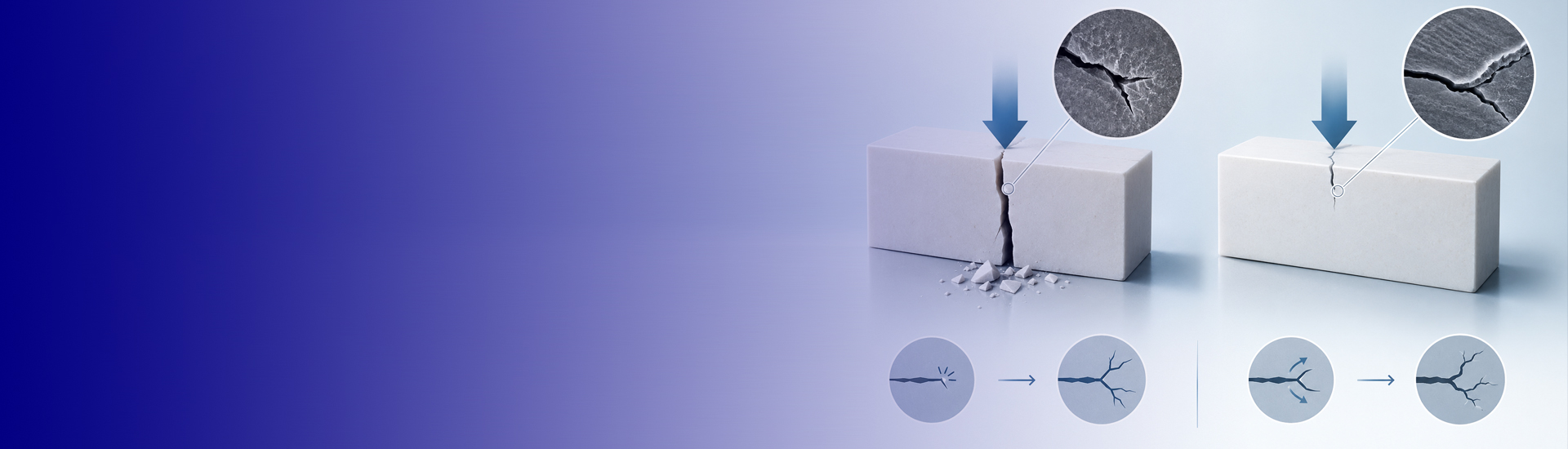
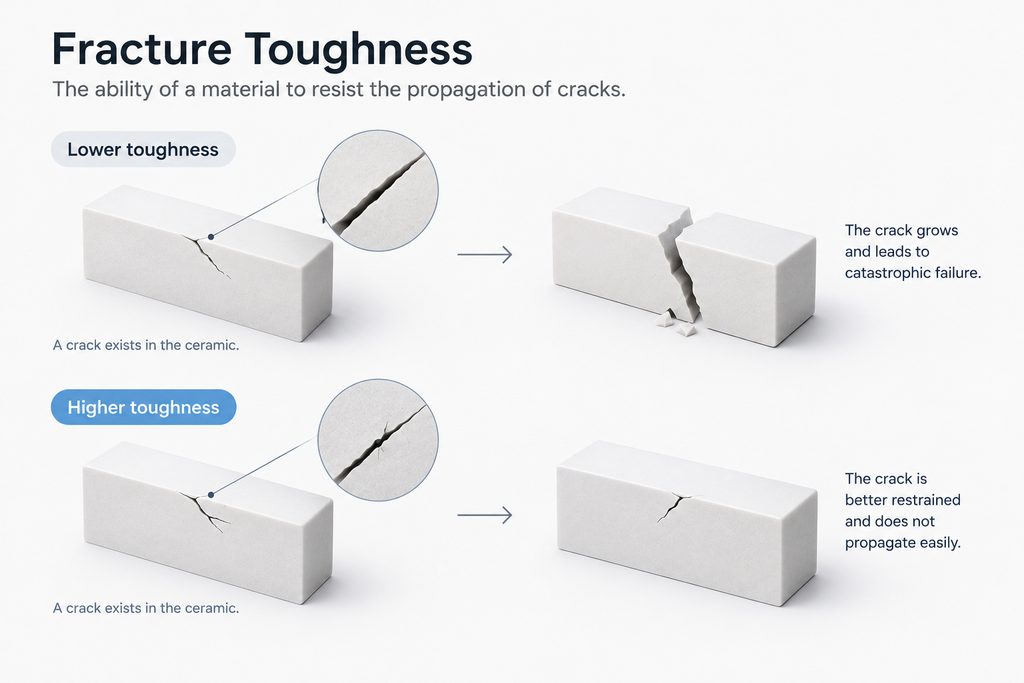
Fracture toughness describes a material's ability to resist the propagation of cracks. In simple terms, when a small crack exists inside or on the surface of a ceramic, a material with higher fracture toughness is better able to prevent that crack from growing and causing catastrophic failure.
This makes high fracture toughness a valuable property for many applications.
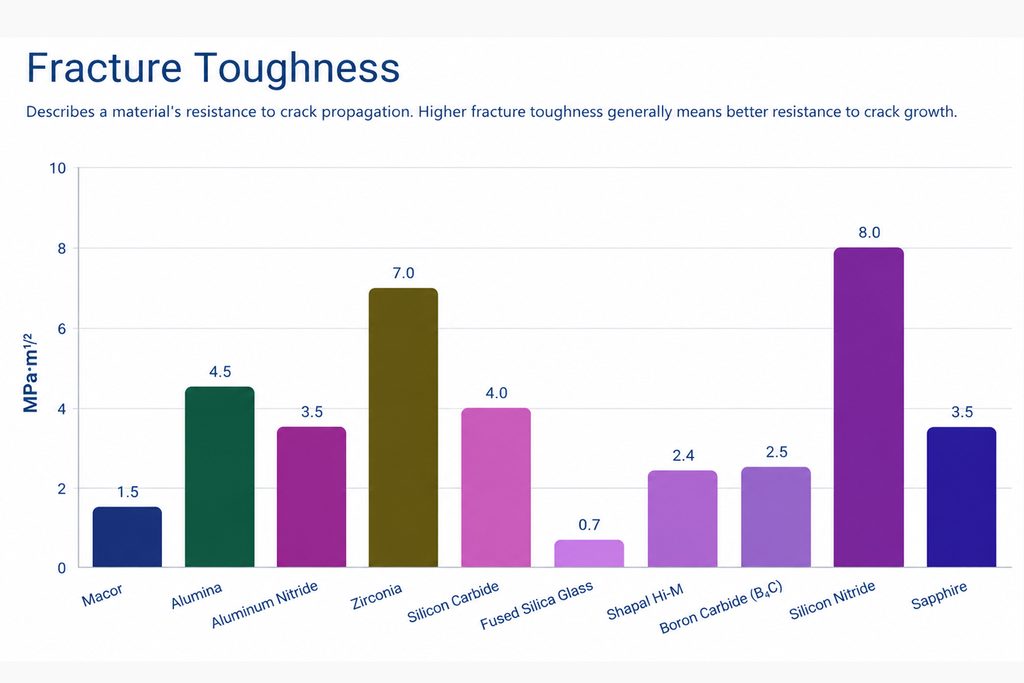
(Click here to view a comparison of fracture toughness between the materials)
Ceramics are naturally brittle materials, but not all ceramics behave in the same way.
A ceramic with higher fracture toughness can better tolerate local stress and resist crack propagation. This can be particularly important for components with mechanical loads, thin sections, small features, or complex geometries.
Zirconia and silicon nitride, for example, are known for their relatively high fracture toughness compared with many conventional technical ceramics.
This can make them attractive when mechanical reliability and resistance to fracture are more important than simply maximizing hardness.
However, there is an interesting trade-off.
What is an advantage for the finished component can become a challenge during machining.
Different ceramic materials can have significantly different fracture toughness, even when they are all considered hard and brittle materials.
Machining and fracture resistance work in opposite directions.
A finished ceramic part needs to resist crack growth. During machining, however, material has to be removed by creating and controlling local damage.
For brittle ceramics such as alumina and silicon carbide, localized stresses can cause small areas of brittle fracture, allowing material to break away during grinding or cutting. Their high hardness still makes tool wear a serious concern, but the way these materials fracture can make material removal relatively efficient.
Zirconia and silicon nitride behave differently. Their higher fracture toughness makes crack propagation more difficult, so material does not break away as readily. More controlled cutting or grinding, smaller removal amounts, and additional machining passes may therefore be required.
In practice, this can lead to longer machining times, higher tool wear, and more process steps, especially when tight dimensions or surface quality are required.
This is why hardness and fracture toughness describe different aspects of ceramic machinability. A ceramic can be extremely hard to cut, yet its fracture behavior may still make material removal relatively efficient.
For a high-toughness ceramic, simply using the hardest possible tool and trying to remove as much material as possible in one operation is not always the most effective approach.
The machining strategy needs to match the material's behavior.
In practice, we may divide the machining process into multiple stages and use different tools for different levels of material removal.
Rather than asking one tool to perform the entire job, several tools can share the machining load through roughing, intermediate machining, precision grinding, and finishing.
The objective is not only to remove material.
It is to remove it predictably, while controlling tool wear, dimensional accuracy, edge quality, and surface integrity.
This becomes especially important when machining thin walls, small holes, narrow slots, sharp features, or complex multi-axis geometries.
There is no contradiction between wanting high fracture toughness in a finished ceramic part and finding the material more difficult to machine.
The two situations are different. Once the part is in service, high fracture toughness helps prevent cracks from propagating and improves resistance to mechanical damage. During machining, however, material has to be removed without causing unwanted cracks or chipping.
This difference matters when selecting a ceramic for a particular application. A material may offer excellent mechanical performance after machining, while requiring more careful control during grinding, milling, drilling, or finishing.
In ceramic machining, the material itself is only part of the equation. Geometry, wall thickness, tolerances, surface requirements, and the machining sequence all affect how the process needs to be controlled.
The goal is not simply to choose a ceramic with the right properties. It is to understand how those properties affect the way the material has to be machined.



Chinese (Simplified)

English

German

Japanese

Spanish
Floors 1-2, Building 3, Qianyuan Industrial Park, No. 2 Gaoxin 2nd Road, Dalang Town, Dongguan, Guangdong, China(523770)